


It began with English on a Saturday. By the fifth session, 60 children were coming voluntarily.
We had started the classes at our school in Kot’olin at the end of January 2026. Without advertising, more and more children joined. Their enthusiasm quickly raised a question: what else could we offer alongside English?
There was room for games, exploration, sport and challenges that asked children to think for themselves. The response encouraged us to develop the sessions into a broader programme: Kelas Masa Depan, meaning “Future Class”.
A Place for Children We Cannot All Enrol
Our regular school offers a close, long-term learning experience, but its capacity is limited. Children normally join us in kindergarten, where they begin building the foundations for the years that follow. Entering later is not straightforward without first developing those foundations.
That leaves many children whom we cannot accommodate in our everyday classes.
Kelas Masa Depan gives us another way to reach them. Every child is welcome, whether or not they attend our school. The programme offers additional opportunities to learn, discover and take part.
The voluntary attendance has been particularly encouraging. The children are choosing to spend part of their weekend here. That gives us a strong starting point: an interest we can respond to with experiences worth coming back for.
A Treasure Hunt with Problems to Solve
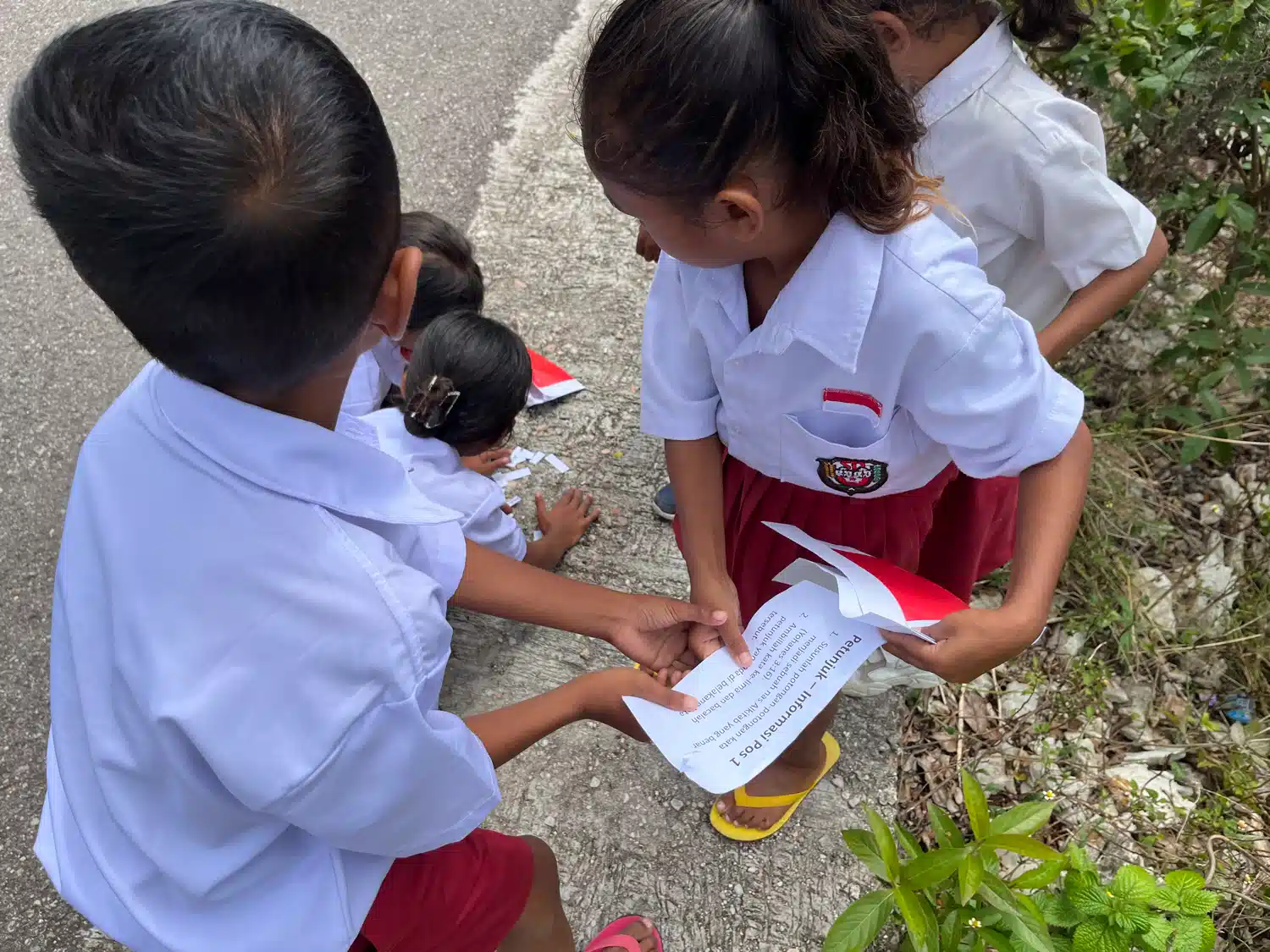
One of those experiences was a treasure hunt designed around problem-solving and reading maps.
In our experience, much of the learning the children encounter at school involves memorising information. We wanted to give them situations where remembering an answer would not be enough. They would need to examine the problem, try an approach and work together.
At one challenge, the next clue was attached to a ball inside a pipe. To bring it within reach, the children had to pour water into the pipe while covering the holes through which it escaped.
Knowing what needed to happen was only part of the task. Making it happen required coordination: holding the holes closed while someone else added water, adjusting when it leaked and keeping at it until the ball rose.
Another clue was hanging in a tree, beyond easy reach. Some of the children came up with a solution by making an improvised tool from wood. They had found a way to extend their reach and retrieve the message.
There were also words to assemble and locations to identify. A photograph led the teams to a small structure in the village, where another clue awaited them. Eventually, they found the treasure map.
Throughout the hunt, the children were running between locations, discussing clues and trying to work out what to do next. The excitement kept them moving; the challenges gave that energy a purpose.
The Map Was a Challenge of Its Own
Finding the map did not mean finding the treasure.
One group kept searching near the place where they had discovered it. The map, however, showed the school grounds. Before they could follow it, they had to make that connection: the piece of paper represented a different place.
Then one of our second-grade pupils surprised us.
We had not yet covered map-reading in her classes, but she interpreted the drawing and led her team straight to the hiding place. The buried treasure was small, roughly 20 to 25 centimetres across, so searching in approximately the right area would not have been enough. She located it with remarkable precision.
It was one of those moments that makes you stop and look again at what a child can do.
The same activity had revealed both an unfamiliar concept for some children and an unexpected strength in another. That gave us something valuable to notice and build on. A map and a hidden box had created a learning opportunity that a conventional question on a worksheet might never have revealed.
An Olympiad for Different Strengths
On another occasion, we organised an olympiad with a wide range of challenges.
Relay races, ball throwing and standing long jump brought movement and competition. Estimation tasks and general-knowledge questions called on different abilities. We recorded the results, evaluated the scores and finished with a ranking announcement.
The variety was deliberate. We wanted children to encounter several ways of doing well, from physical skill to careful judgement and knowledge.
Planning for children aged roughly seven to 15 also meant thinking about different levels of difficulty. The tasks needed to be understandable and engaging across that range, with room for children to work independently and with one another.
Preparing and evaluating the activities took considerable work. The children’s motivation made that effort worthwhile.
English and a Wider View of the World
English remains an important part of the programme, with focused learning alongside games and other activities.
We have also played an adapted version of Tchoukball and shown documentaries, including some in English. These bring another dimension to the sessions: opportunities to hear the language while encountering places and subjects beyond the children’s immediate surroundings.
In a remote community, access to that wider world can be limited. A documentary, a new game or a question about geography can become a starting point for curiosity.
We want the programme to offer that variety. Some sessions ask children to concentrate on language. Others invite them to move, observe, estimate or solve something together. The common aim is to make learning something they actively participate in.
Keeping the Door Open
I currently take responsibility for developing the programme. While I am away, our English teacher continues the sessions every two weeks.
Our intention is to develop Kelas Masa Depan as a lasting part of our work. That means finding a balance between varied activities, the needs of different ages and what our team can prepare and run consistently.
There is still plenty to learn about how best to do this. The attendance tells us that children want to come, and the activities give us opportunities to observe how they engage. Longer-term progress will take time and continued attention.
But the beginning is already meaningful. Our school has a limited number of places. Through Kelas Masa Depan, many more children can walk through its doors, take on a challenge and discover something they did not know they could do.