


We expect children to learn every day. A school should be able to do the same.
A teacher discovers a better way to explain something. A conversation with parents changes how we understand a child’s absence. An activity reveals that children need more time to experiment before an explanation makes sense. Each experience has value beyond that single moment.
Yet these insights are easily lost. They remain in someone’s memory, in a message, or in a conversation that a future colleague will never hear.
We want to build a school where experience accumulates. Where new teachers inherit more than a timetable and a set of textbooks. Where they can understand what we are trying to achieve, draw on what others have learned, and contribute discoveries of their own.
That is the vision behind the EGI Learning System: a school that becomes more capable as it learns.
When too many answers depend on one person
As our school in Kot’olin developed, I began to recognise a recurring pattern. I would work through a problem, find an approach, explain it to the team, and move on. Later, a similar question would arise, and much of that explanation would begin again.
Some questions concerned teaching. Others involved working with parents, organising materials or responding when a child repeatedly missed school. The answers often depended on experience with our particular school and community. They were not things a teacher could simply look up online.
We were building knowledge, but too much of it still depended on individual people, including me.
That creates a limit. When the same person must repeatedly explain, decide and follow up, the organisation can only move as quickly as that person’s availability allows. Being away makes the weakness especially visible.
For a school intended to serve generations of children, this matters. Our experience needs to remain useful beyond the people who first gathered it.
Giving experience a place to grow
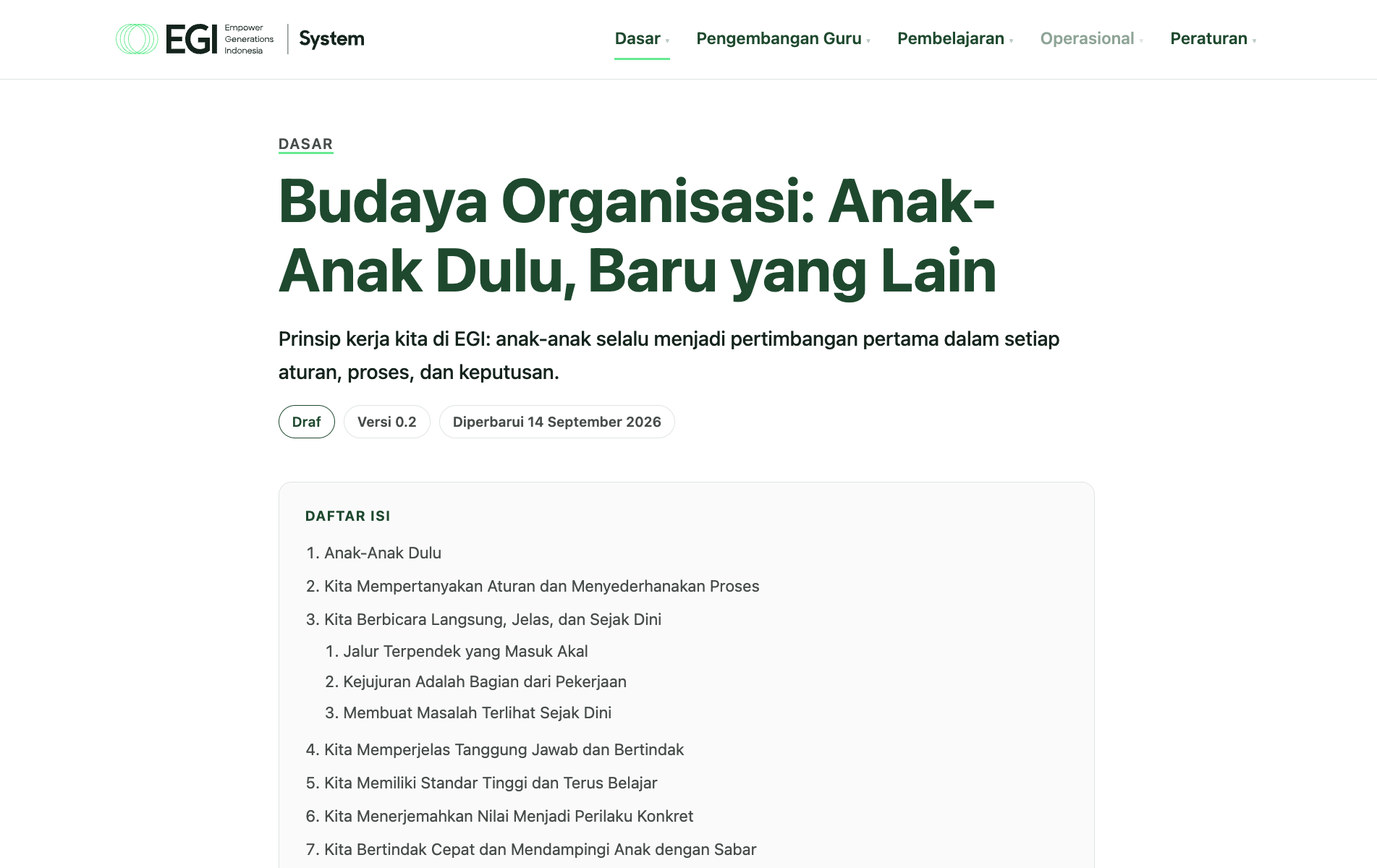
The EGI Learning System, or ELS, is the shared knowledge platform we are building to make that possible.
It brings together the foundations of our school, practical guidance for teachers and the knowledge needed to run the organisation. The intention is to connect the questions people encounter in their work with clear explanations and useful next steps.
A statement such as “we put children first” has little practical value unless we explore what it means when planning a lesson, responding to a difficulty or deciding how to spend limited resources. Equally, a procedure is easier to apply intelligently when people understand why it exists.
ELS connects those levels: what we believe, what we are trying to achieve, and how that translates into everyday decisions.
Our vision, mission, values and foundational principles are already documented, with deeper explanations that make them more than a few sentences on a wall. From this foundation, we are developing the practical knowledge that helps people put them into action.
Supporting the thinking behind good teaching
A collection of activities can save preparation time. But the deeper opportunity is to help teachers understand what makes an activity valuable.
Take a simple group game. Children may be moving, laughing and following instructions. Behind that, there can be opportunities to practise coordination, language, cooperation, concentration or handling frustration.
The teacher’s role makes a difference. What should they observe? When should they offer help? When should they step back? How can the activity be adapted for children who find it too easy or too difficult?
These are the kinds of connections we want ELS to make explicit.
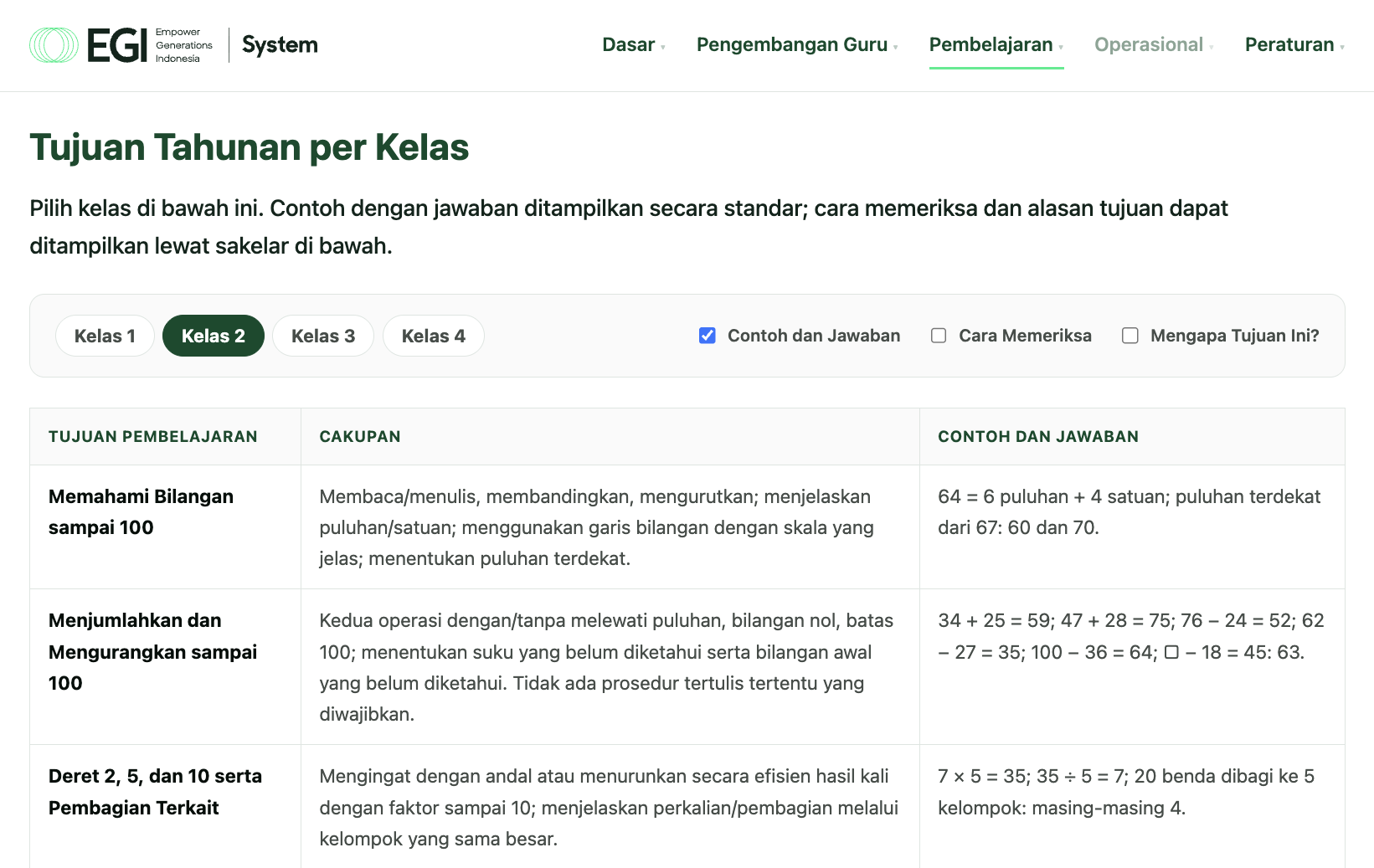
Over time, practical activities, learning goals and teaching guidance can support one another. A teacher looking for an activity should also find its purpose and the reasoning behind it. A teacher working towards a particular learning goal should be able to find suitable approaches.
This gives teachers more than instructions to copy. It gives them a stronger basis for making their own decisions.
It also makes experience easier to pass on. The insight of an experienced educator can continue to support colleagues after a visit has ended, rather than depending on everyone remembering what was said.
Five areas, one connected school
We have organised ELS into five main areas. Together, they reflect the fact that educational quality depends on much more than what happens during a lesson.
Foundations
Our vision, mission, values and educational principles provide a common direction. This area explains the thinking behind our work and gives the team a reference point for decisions.
Teacher Development
A school’s ability to improve is closely connected to the development of its teachers. This area includes professional learning, reflection and personal development, as well as the habits and wellbeing that support sustained, thoughtful work.
Learning
This is where curriculum, learning goals, activities, games and teaching materials belong. The aim is to connect what children should learn with practical ways to help them get there.
Operations
Working with parents, managing materials, maintaining facilities and organising daily routines all affect the conditions for learning. Making this knowledge accessible reduces repeated explanations and helps work continue reliably.
Rules and Responsibilities
Clear expectations, rights and responsibilities help people act with confidence. Knowing who is responsible for what makes cooperation easier and reduces unnecessary uncertainty.
These five areas form the structure of the platform. Our five foundational educational principles, which we will explore separately, sit within that wider structure.
A school that remembers and improves
Documentation alone does not make an organisation learn. A platform can become outdated just as easily as a folder on a shelf.
The important part is what happens when experience challenges the guidance.
If an approach repeatedly causes confusion, we need to improve the explanation or reconsider the approach. If a teacher finds a better way, that experience deserves attention. Once a useful improvement has been reviewed and incorporated, it can become available to everyone who faces the same question later.
Not every new idea should immediately become school policy. There needs to be room to test, discuss and distinguish a promising thought from an approach that works in practice.
But once we have learned something useful, we should not have to learn it from scratch again.
In this sense, ELS is becoming an operating system for the school: a shared basis for how we work, make decisions and improve. Its value lies in how well it supports the people using it.
Structure that makes independence possible
There is a tension here. Schools need consistency, but teachers also need judgement and room to respond to children.
Our aim is to make those two things support each other.
When the purpose is clear and relevant knowledge is easy to find, teachers have a stronger foundation for acting independently. They do not need to wait for someone else to answer every recurring question. New colleagues can understand the reasoning behind established practices, and responsibilities can be shared more effectively.
That also means being selective about administration. Every form, report or procedure takes time. It should help someone prepare, reflect, coordinate or make a better decision. Otherwise, we need to question whether it belongs.
The measure of success is whether ELS makes good work easier and educational quality more dependable.
Building something that can reach further
ELS is still developing. The foundations are taking shape, and practical content will continue to grow through work with our team and experienced educators. Digital tools and AI can help us organise knowledge, formulate explanations and work across languages. The substance must come from educational understanding, local experience and careful judgement.
The longer-term potential is significant.
An improvement in one lesson benefits the children present that day. When the insight behind it becomes clear and reusable, it can also benefit future classes, new teachers and eventually other schools.
That is the kind of multiplication we are working towards. Buildings give us room to welcome more children. Shared knowledge gives us a way to carry what we have learned into that growth.
I want our school to become less dependent on my presence and better able to build on the experience of everyone involved. A school where each new teacher starts with more support, each useful discovery travels further, and the organisation keeps learning alongside its children.